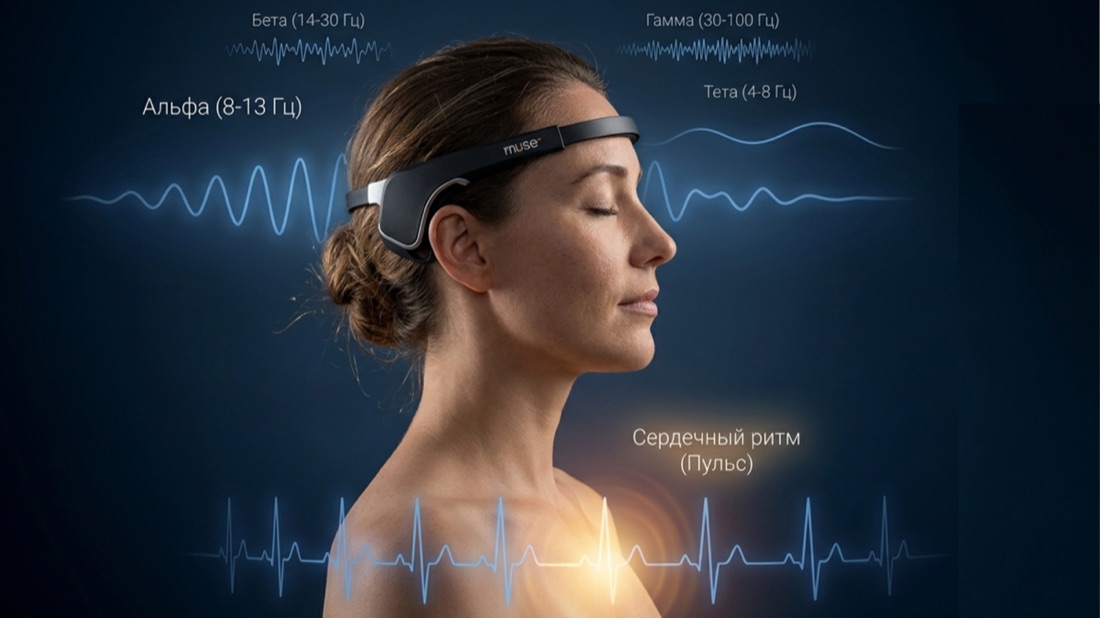
EEG · Muse 2 · KADI / Guidance School
The brain quietens while the heart wakes up: what does conscious focusing do to a person?
What happens in the brain and body when a person deliberately changes their mode of attention? Five practitioners of the KADI Transgressive Focusing method entered ten states in turn — from the ordinary, thought-hopping “Mind” to “Higher Self”, “Soul”, “Guide” and “Teacher” — while a Muse 2 EEG headband recorded their brain rhythms and heart activity, and after each session participants described aloud what they had experienced. An independent analysis of these recordings produced three unexpected results:
- focusing “tunes” the brain like a radio to a station;
- attention has not only “volume” but also “tempo” — and these are different things;
- and — most unexpectedly — a calm mind does not mean a calm body: in the states where the brain quietened most, the heart, on the contrary, beat faster.
And in some focusings the participants lived through very vivid inner events that the instrument barely registered — which shows its limit: an EEG headband does not catch everything.
Imagine two people sitting side by side with their eyes closed. The first is intently solving a hard problem in their head — adding numbers, weighing options, analysing. The second has entered a deep meditative state that, in their practice, is called the “Teacher” focusing — outwardly it looks like complete stillness and detachment. The question: whose heart, in that minute, is beating more calmly?
One is tempted to answer: the second, of course — they are relaxed, while the first is strained. But when we looked at the actual pulse recordings, it turned out to be exactly the opposite. In the person who was merely thinking hard, the heart beat more calmly than in any other state in the whole experiment. And in the person immersed in the quiet, collected “Teacher” attention, the pulse instead sped up. So in those minutes the brain was quietening while the heart was, on the contrary, activating.
This is only one of three unexpected results we were able to see in the data, and below we examine each in detail — what exactly was found, why it is not a coincidence and, above all, what it may mean for a person who is learning such a practice.
Besides the instruments we have a second source of material — transcripts of the sessions themselves, where after each one participants described in their own words what they had experienced. This lets us do a rare thing: check whether the inner experience matches what the sensors showed. Most often it matches surprisingly closely — and where it diverges, the mismatch itself turns out to be a finding. But first we must honestly answer a fair question: can a light “headband” costing a couple of hundred dollars be trusted at all with something as subtle as brain activity?
A “fitness gadget” with a serious scientific record
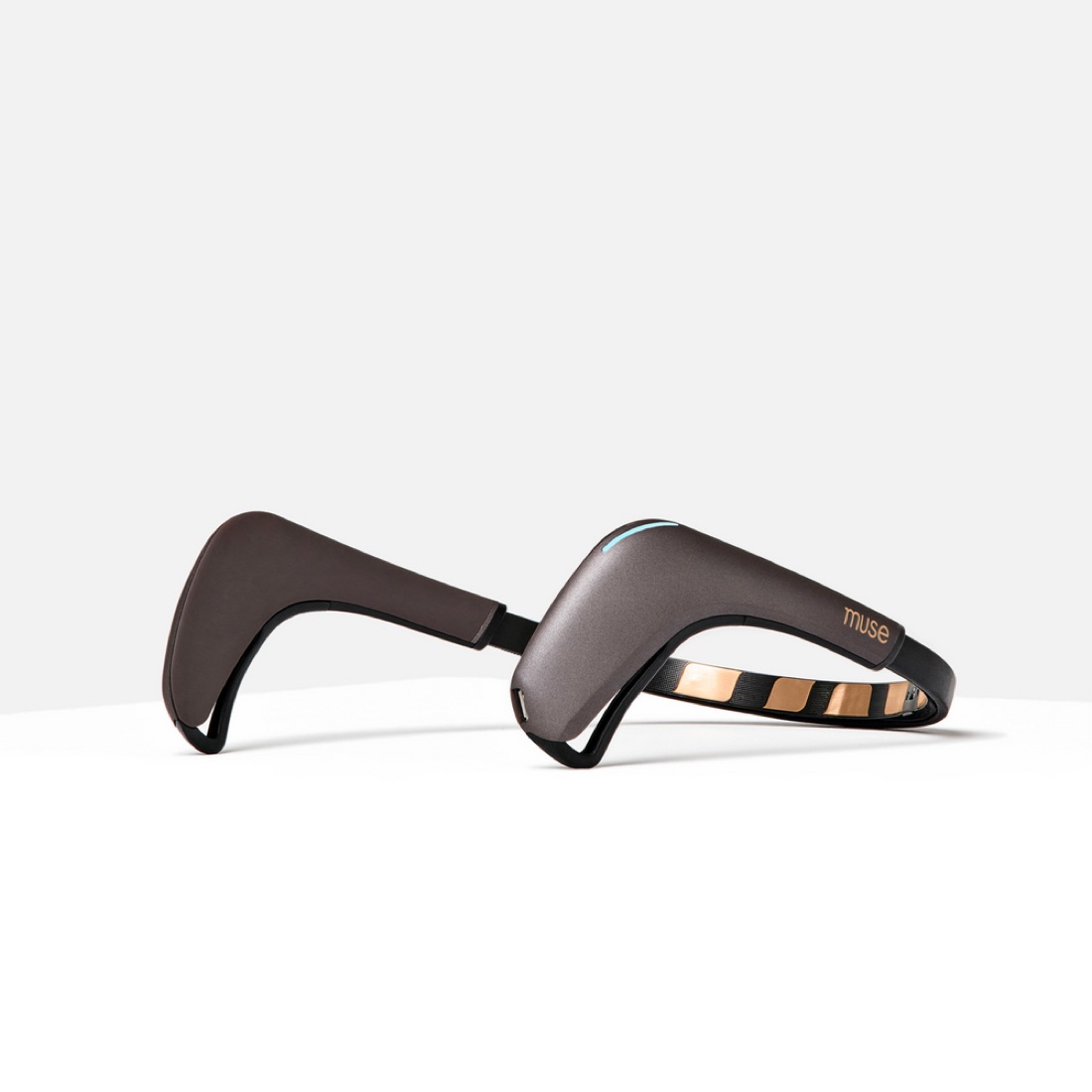
Measurements were taken with the Muse 2 — a wearable EEG headband from the Canadian company InteraXon. It has four electrodes (two on the forehead and two behind the ears), needs no wires or conductive gel, and goes on in half a minute. It is sold as a gadget for meditation, but behind the consumer look hides an instrument trusted in real science.1, 8
Muse has been used in more than two hundred peer-reviewed studies. Labs at NASA, Harvard, MIT and the Mayo Clinic have worked with it, as have the universities of Toronto, London, San Diego and Victoria.7
At the University of Victoria, EEG was recorded on this device from a full thousand people, studying how quickly mental fatigue builds up — a scale that would have been impossible with bulky clinical equipment.2 At the Catholic University of Milan it was shown that a month of regular practice with Muse noticeably lowers stress compared with a control group.6 And the Mayo Clinic used the device as a meditation tool for patients awaiting surgery, recording reduced anxiety and fatigue in them.
The device also has an honest limitation worth stating. Four electrodes is very few compared with clinical systems, which have anywhere from 64 to 256. Because of this, Muse simply cannot show which particular region of the brain something is happening in — it sees activity only in broad strokes. But the main thing it was built for, it measures reliably: the overall level of brain activity and the balance of its main rhythms. In scientific work based on these data, states of relaxation, neutral rest and focused work can be told apart with 87 to 99 percent accuracy.5 And since our task was not to build a map of the brain but to compare different states of the same person with one another, that accuracy was enough.
A short EEG glossary: five brain rhythms
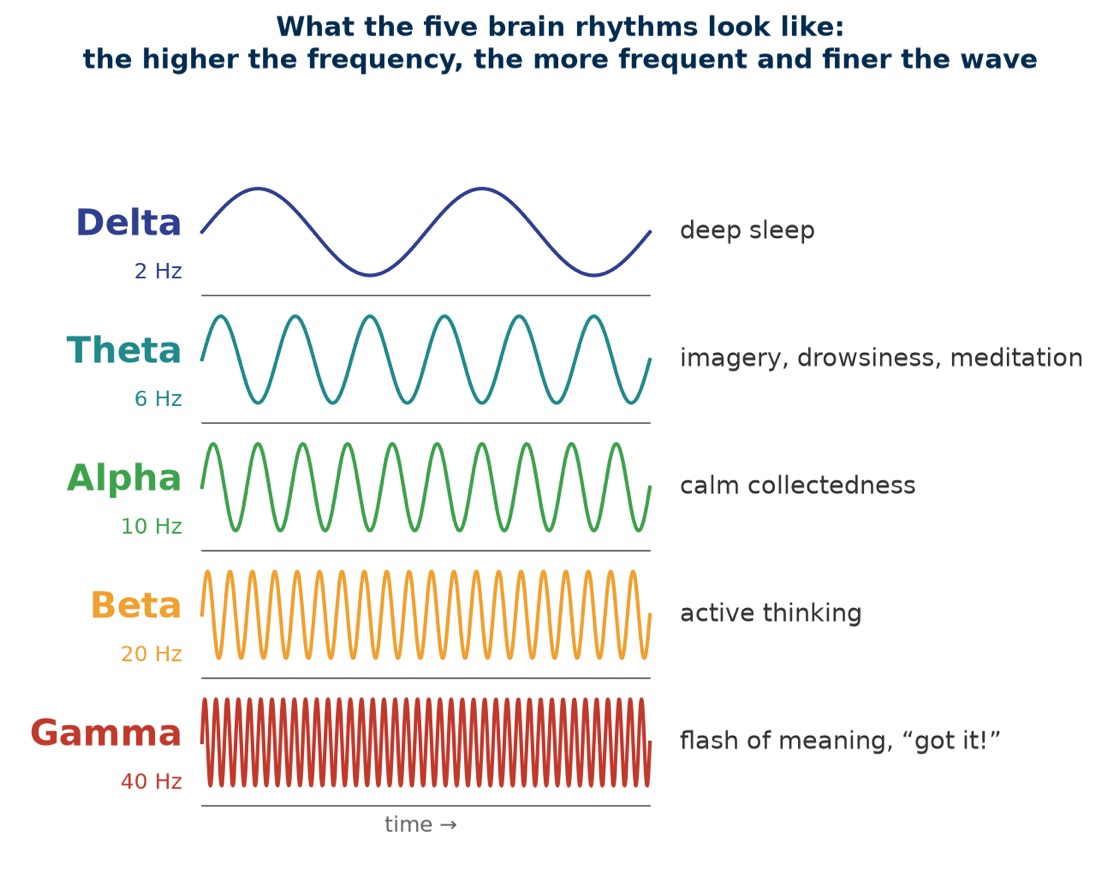
The brain continuously generates electrical oscillations of different frequencies, and each frequency band roughly corresponds to its own “operating mode”. Here are the five rhythms we will be talking about:
Besides the individual rhythms, their ratio will be useful — alpha to beta (α/β). The easiest way to understand it is as “calm divided by tension”: the higher this number, the more calm concentration there is — the mind is quiet and collected, but not drowsy; clarity is kept.
What these states are — “types of attention focusing”
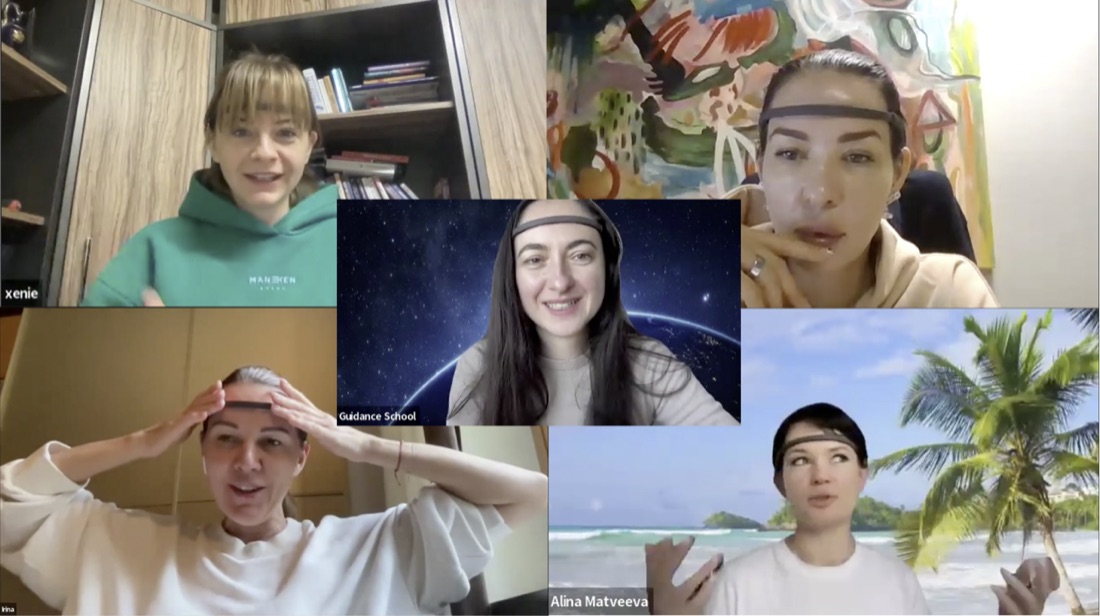
The setup was this. Five experienced practitioners (including the method's author, Ksenia Kadi) went through ten states — each serving as their own control for comparison (a within-subject design), which gave 70 sessions and ~66,000 data points. The group gathered in a shared Zoom, everyone put on their headbands and entered the same focusing state in sync, held it for 15 or 30 minutes, and then took turns sharing aloud what they had experienced.
Focusing aimlessly is hard and pointless. So every session had a theme — money, the “shift from a survival mode into a mode of development and creativity”; it was on this theme that we tested how different types of focusing change one's view of a chosen task. At the end we will also share the results of a survey of the participants about their changes in the area of finances, but first, the EEG study.
Before talking about what the instruments showed, we need to explain what the practitioners were actually doing. The Transgressive Focusing method invites a person to switch their attention, in turn, onto different “levels of attention”. These are not simply different degrees of relaxation — each carries its own particular inner skill and its own purpose. Here is how the practice itself describes these states. (As noted above, the names are labels for modes of attention, not claims about external beings.)
Higher Self — the “structural architect”
This is a mental structure that connects the everyday work of the mind with a deeper “Soul consciousness”. It is neutral towards the desires of the ego and works like a translator: it turns vague, abstract impulses into concrete plans, schemes and sequences of action. In this state, access opens to a broad field of information and meaning. Such a focusing is useful when you need to structure thoughts, write texts, or find the best way to solve a life task.
“It is a more neutral, more objective view”, “more reasonable, wise, calm”.
“I saw different little streams — as if different sources are needed from which money can come; and then a sense of sufficiency builds up”.
“A visualisation started: it is as if I am in the shape of an iron barrel and have to roll over — from one pool into another… to move into a new field of activity!”.
Soul — “life meaning”
This is the living, non-rational element in a person, a kind of “great navigator” that operates not through logic and words but through intentions, impulses and a sense of the right direction. The “Soul” level of attention is responsible for inner connectedness with oneself, for confidence and for the sense of meaning of one's presence in the world. Such contact returns richness to life and protects against a feeling of being lost and of devaluing one's own effort.
“Oh, my Soul is not interested in finances at all — it kept flying off somewhere; the focus slipped away”.
“It is interested in contact, in touching people, in belonging — it actually brings me to tears, this is key for it”.
“Nobility, breadth, calm… self-respect while in contact with the theme of money”.
Guide — the “external stabiliser”
Here the practitioner uses the position of an outside observer as a tool of self-regulation. They concentrate on the image of a “kindred spirit — a companion” who accompanies the person and remembers their deep design. The practitioner moves part of their attention outside themselves in order to look at the situation from the side. Such a view reduces the power of emotions, helps notice recurring mistakes and hold direction. In the study there were two versions of working with this level of attention: “Guide — focusing” (holding the position, the angle, the gaze itself) and “Guide — receiving text” (when this inner position is translated into words and written down).
“It showed me about rhythm — a different rhythm, a different breathing, right in the body — and brought attention back: sit firmly inside yourself”.
“A light room, all in light; you enter — and it becomes spacious, as if everything is subject to you, a completely different state”.
“It told me about the laws of physics, about fields, about charge — and it is directly connected with the financial sphere”.
Teacher — the “strategic catalyst”
This is turning to the image of a more developed and competent “other”, who serves as a reference point for growth and responds to your request to learn, “who understands, like no one else, what most interests you on the path and has already gone far in that skill”. Such a focusing triggers a reassembly of habitual ways of thinking, raises the likelihood of insights, and helps you go beyond standard solutions; as a result, learning accelerates and a more strategic view of things emerges.
“So much energy came — I have not felt such an energising in a long time, literally like currents”.
“Something very serious, tender; it taught me to connect consciousness with the body — I take clay, it turns into legs, arms, and I come into my body”.
“With the Teacher it is a bit strange — it said: let's drop the excess — and we dumped it all as if into a chute”.
Besides these “working” states there were simpler ones, including two controls against which everything else was compared.
Observer is ordinary relaxed observation of the breath, without active thinking — the closest thing to classic meditation.
Mind is unorganised everyday thinking about current affairs, the very state in which the average person spends most of the day.
Active Mind was created by playing online Scrabble: it gave the brain a clear mental load and served as a model of “ordinary focused work”. There were also the focusings Earth's Information Field (a state of contact with the shared information space, maximally detached from the external) and Group Guides (a version of working with the position of a collective observer and companion).
Mind: “The body is tense when I think about this shift; I tried to relax it — wow, how the lower back tightens at the very idea of money”.
Active Mind: “A game that does not require speed — a calm working state, my own creativity rather than absorbing information”.
Observer: “Everything seems calm, but the neck starts to tense, it is hard to hold the head up”.
Information Field: “Such an angle: look right under your nose — the road is right from under your feet”, “It is like a re-flashing at the cellular level regarding the understanding of money”.
Group Guides: “Each of us in a little swan-boat with their own guide… they seemed to draw a platform with big pencils, and at the end they joined hands and launched it into work”.
Importantly, all the states are arranged into a ladder by difficulty of tuning the focus — and together they form, in effect, a map of the practitioner's path. At the bottom is what is accessible to anyone without preparation; higher up is what demands ever more skill. Here is that ladder, from simple to hard:
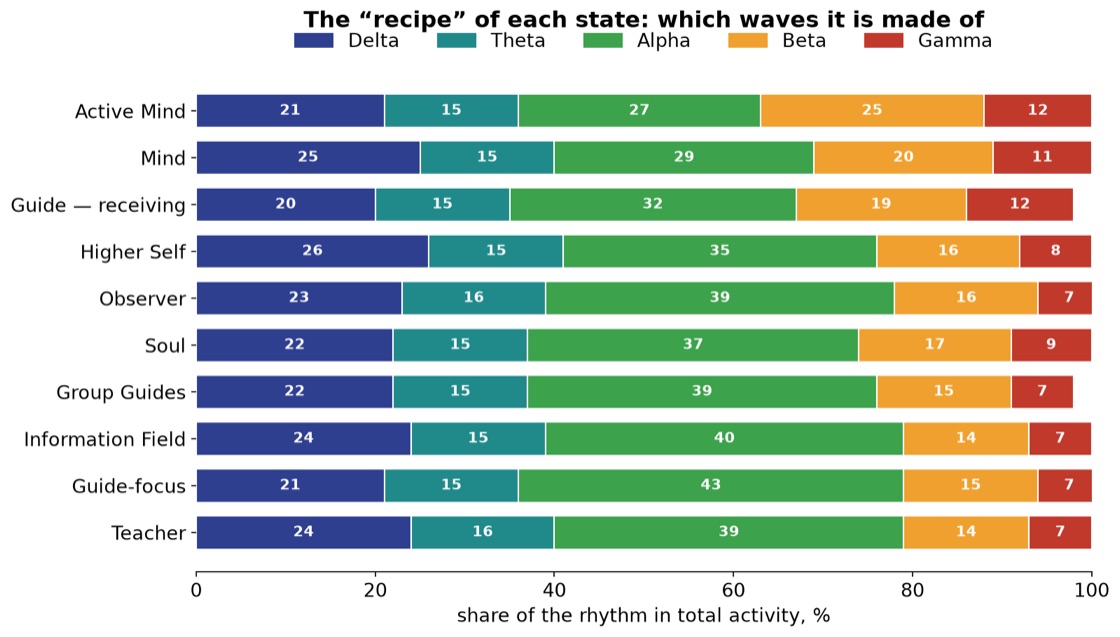
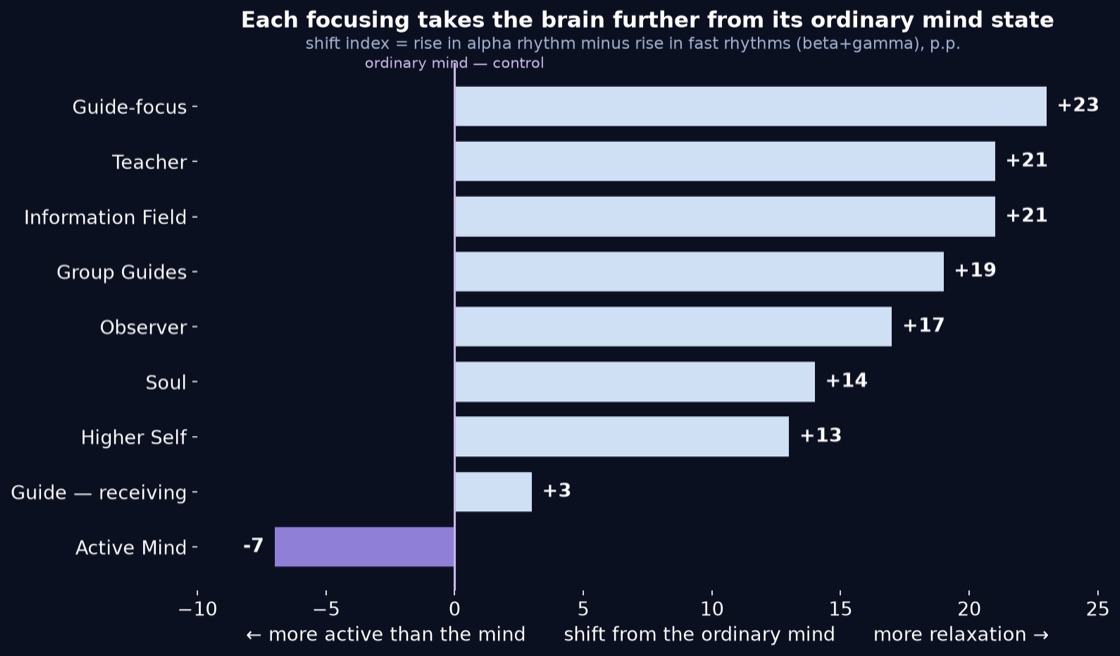
We will return to this ladder at the end — to check whether the instruments see it (spoiler: they do, but not the way you would expect). And now — the three main results. But first, let us look at one chart that immediately shows the difference between states. If you break each focusing down into its “composition” — what share each of the five brain rhythms takes up in it — then the smooth transition from “active” states to “collected and deep” ones is visible to the naked eye.
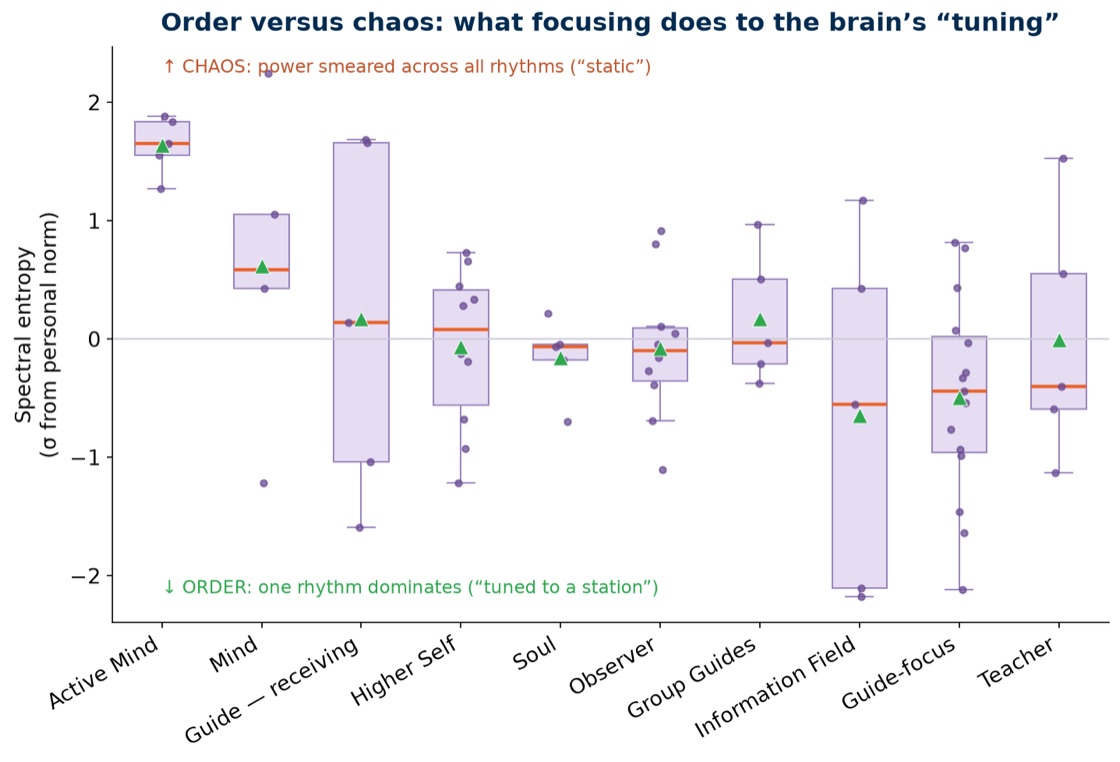
Imagine turning the dial of an old radio. Between stations you hear a hiss — energy is smeared across the whole band of frequencies, and no single signal stands out. But the moment you catch a station precisely, one clear voice emerges from that noise. Roughly the same thing happens with the brain's electrical activity, and this “tunedness” can be measured with a single number that science calls spectral entropy. If entropy is high, power is spread more or less evenly across all five rhythms — the brain “hisses on all frequencies”. If it is low, some one rhythm comes forward and becomes dominant — the brain is “tuned to a station”.
When participants played Scrabble, their brain worked precisely in that noise mode: energy spread across all rhythms at once, and spectral entropy rose higher than in any other state. During the focusings the opposite happened — one rhythm began to dominate clearly, and entropy fell. The difference between “active” states and “collected” ones proved stable and statistically significant, and in a direct comparison of “Scrabble” with the “Guide-focus” state, entropy was higher in the game in every participant without exception.
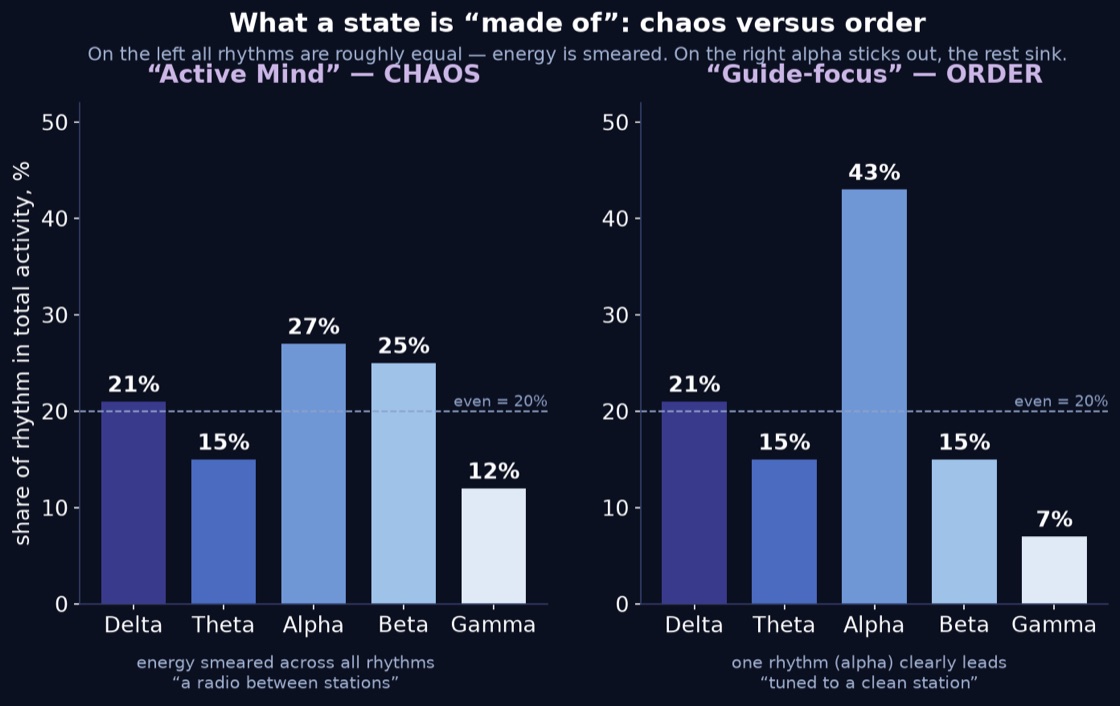
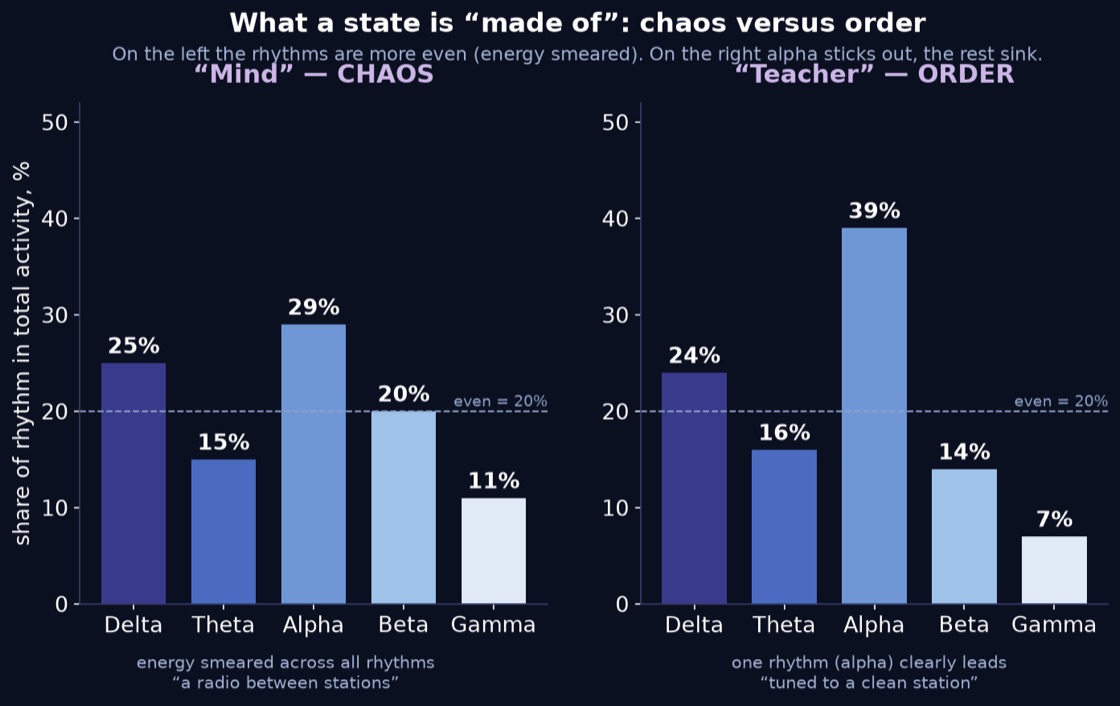
This “noise on all frequencies” is clearly audible in the way the participants themselves described the ordinary mind. “It kept jumping, it jumped all the time… kind of nervous. And I did not feel particularly relaxed” (about the state in which the mind simply looked at the theme of money). “The mind, it turns out, has a heap of tension about this… the body is tense, all the time you have to monitor something, regulate something”. A jumping, monitoring mind that finds no rest — that is the verbal portrait of high spectral entropy.
We must be honest: this measure is closely linked to that same ratio of “calm to tension” (α/β) — the more the relaxed alpha dominates, the lower the entropy. So this is not some entirely separate phenomenon, but rather a different, more holistic angle on the same reorganisation. And that angle matters for this reason: it shows not the strength of one separate rhythm, but the layout of the whole electrical picture of waves at once.
Focusing does not simply “add relaxation” — it brings order to the whole electrical choir of the brain, making it sound around a single leading voice instead of a discordant hum.
The same pattern has been found in experienced practitioners. In a study of highly skilled meditators — people with an average of about 22,000 hours of practice in the traditions of shamatha, vipassana, dzogchen and others — exactly the same was found: during meditation the complexity of the EEG signal decreased compared with mind-wandering.4 The authors explain it thus: with concentration, the brain has “fewer possible configurations” — consciousness carries less scattered content. In other words, experienced contemplatives “tune the station” exactly the way the participants in our study did, with 1–2 years of practice and more.
This gives the practitioner an objective sign by which to tell real concentration from mere busyness of mind. You can sit “in your affairs”, turning thoughts over — and the brain will be hissing on all frequencies, like a radio between stations. Or you can enter a collected state — and the activity will line up around a single rhythm. In other words, the practice trains not “relaxation” as such but one-pointedness — the ability to gather attention into a single point instead of the habitual scattering onto everything at once. This is exactly the quality of mind opposite to the endless multitasking background of modern life. And now this collectedness has a measurable sign: by it you can see whether attention really has gathered to a point, rather than only seeming to — and you can train, relying on it.
Muse measures not only the brain but also the pulse, and this made it possible to ask a question that usually stays off-screen: do brain and body move in the same direction? Common sense says yes: if the brain calms down, the heart should slow too, since both are about “relaxation”. We compared the overall level of brain arousal with the pulse across all states and expected to see a smooth dependence. Instead, the link turned out to be practically nil — brain and heart behaved as if following independent scripts.
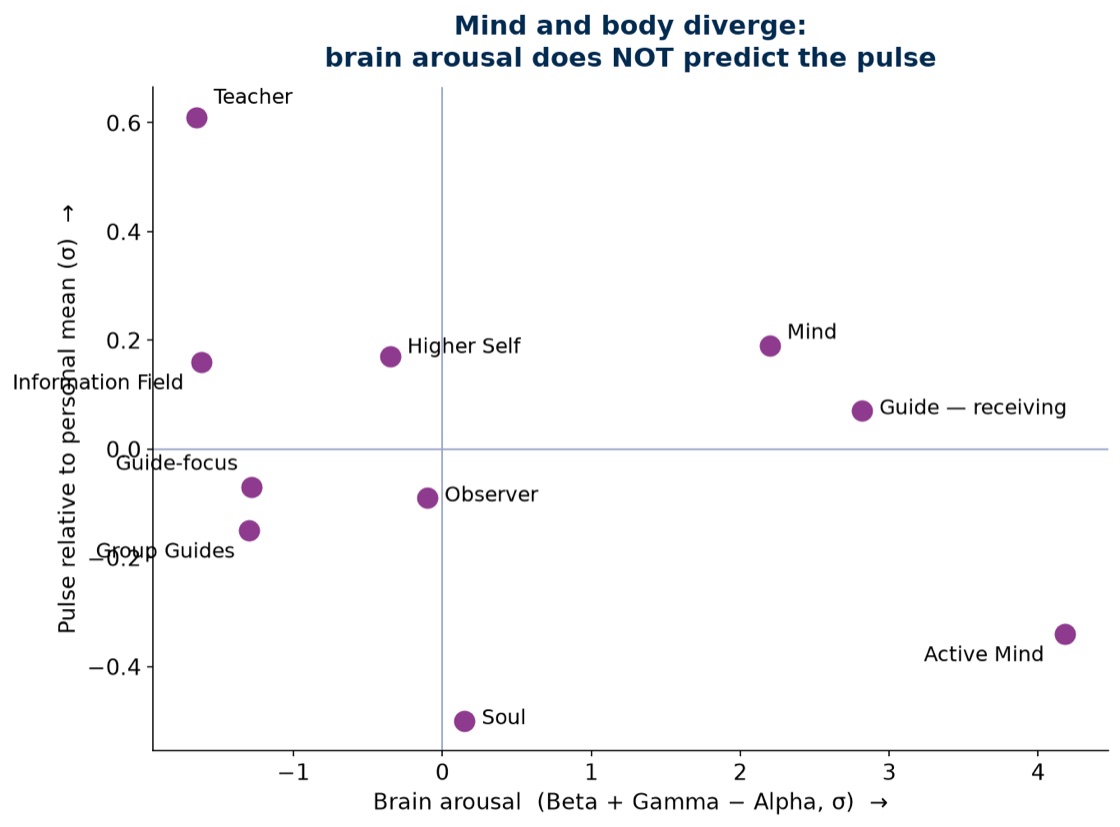
The easiest way to understand what this means is to look at the “corners” of the picture. In the game of Scrabble the brain was revved to the limit — the person was actively thinking — but the heart beat slower than in any other focusing: the mind worked while the body stayed at rest. In the “Teacher” focusing it was exactly the reverse: the cortex quietened more than anywhere else, but the heart, by the end of the session, sped up by almost 7 beats per minute. That is, outwardly the person was in deep calm, while their body was noticeably getting to work — the pulse rose as if the organism were mobilising, even after the thoughts had gone quiet. In the “Soul” state there was a third, separate picture: the calmest heart in the whole experiment — the pulse was not only low, it went on falling over the session.
The most striking thing is that this split is audible in the participants' own words. Of “Teacher” — the state with the quietest cortex — they said: “So much energy came… I have not felt such an energising in a long time, literally like currents”; “as if I was learning to reconnect consciousness with the body… and it returned me to the body, my breathing quickened”.
Of “Higher Self”, which subjectively felt “calmer, more balanced, of a different class”: “I fought off sleep the whole way… drifting into sleep and coming back” — while, judging by the data, the heart in those very minutes was speeding up.
Of “Soul” — the most relaxed subjective feeling and body by the instruments: “Soul is not interested in finances at all, it kept flying off somewhere”; “breadth, calm”. Here body and words match perfectly.
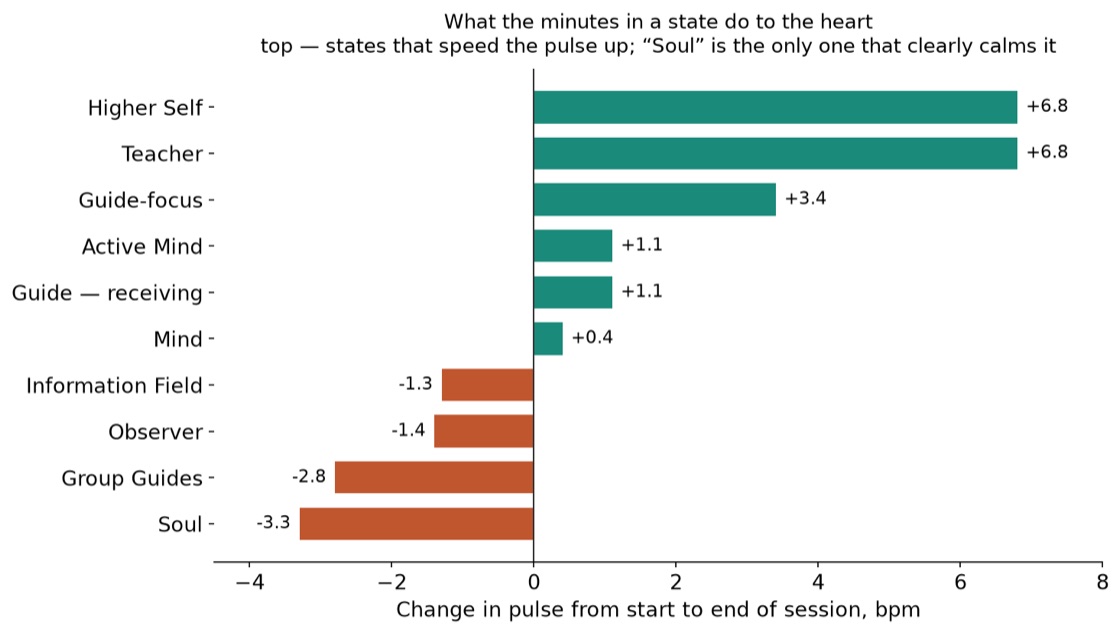
It turned out that the focusings the practice considers high calm the head — but at the same time wake the body. The exception is the “Soul” focusing.
The main conclusion here is that a “calm mind” and a “calm body” are, it turns out, two different things, and they need not coincide at all. Curiously, the measured picture fits well with how the practice itself describes these states. “Soul” in it is about calm, connectedness and meaning, and the body in it does indeed relax. “Teacher” and “Higher Self” are about activation, reassembly and catalysing the new, and the body responds to them with a quickened pulse — as if reacting not to physical effort (there is none) but to inner intent.
For the practitioner a very concrete conclusion follows: do not judge your state only by whether the thoughts have gone quiet. You can be completely quiet in the head and yet physiologically activated — and this bodily activation appears to be part of the “work” happening in those minutes. In practice this hints at how to match a state to a goal. If the task is to recover, to calm the nervous system, to come back to yourself after overload, the tool is the “Soul” focusing: it is the one that truly slows the heartbeat. But if you need to engage in complex, innovative work, then “Teacher” and “Higher Self” give a clear, quiet head with a mobilised body — and precisely for that reason they should not be used as a way to “relax before sleep”: the body in them does not rest, it works.
The third angle concerns not how much relaxed alpha wave a person has, but the rhythm in which it pulses. The thing is that alpha never stands still: it constantly ebbs and flows. The question is how often this happens — in short quick bursts or in long smooth waves. We measured the tempo of alpha-rhythm modulation — how fast the amplitude of alpha waves rises and falls: in frequent short oscillations or in long smooth “spindles”.
For clarity, picture waves on the sea. The “strength” of attention is the height of the wave, that is, how much calm attention a person has. The “tempo” is how often the waves roll in: as a fine frequent ripple or as rare long swells. Two different parameters of the same water: there are low and high but frequent waves, and low/high slow ones. It is exactly the same here — how much calm attention a person has (alpha waves) and the rhythm in which it sways are different characteristics.
It turned out that during Scrabble (Active Mind) the power of the alpha rhythm trembled fast and jaggedly — the characteristic time was about 2 seconds. But in the states of observation and reception — “Observer” and “Guide — receiving text” — it flowed in long, smooth waves of 6–7 seconds. Attention in these states seems to breathe noticeably more slowly. This effect proved statistically significant and, importantly, it does not depend on whether a person has a lot of alpha waves or few — that is, it is an independent characteristic of the state.
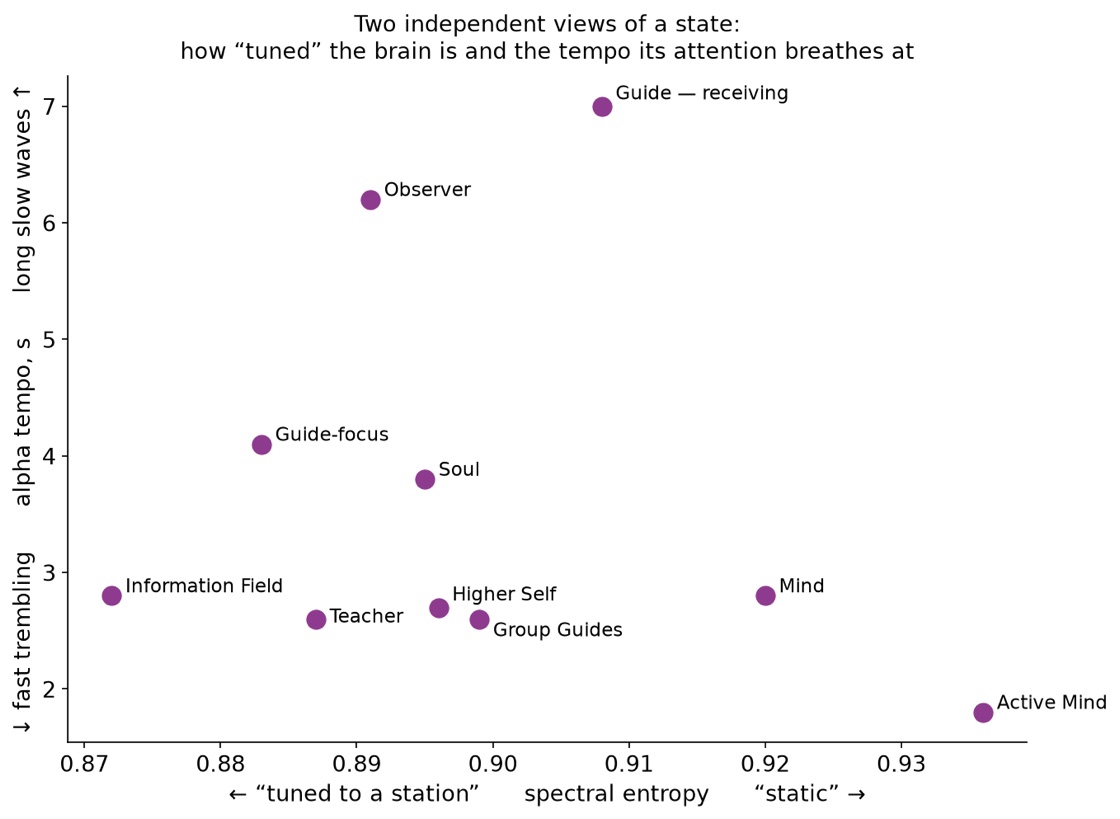
The long, unhurried wave of attention in the “Observer” is well conveyed by the participants' impressions: “At times it was like this — you are just present, you really have no thoughts… like contemplating your own consciousness”. This is not feverish “tracking” of what is happening but a broad, calm holding of focus — exactly what looks on the chart like slow, drawn-out waves.
It turns out attention has not only a “volume” but a “tempo”, and these are different measures. The position of the calm observer produces a slow, drawn-out rhythm of attention — attention here does not dart about but is held broadly and steadily. This is precisely that “spacious”, unhurried collectedness sought in contemplative practices. For the practitioner, a long, slow wave of attention can serve as a sign that they have genuinely entered a stable contemplative state, rather than merely, in a relaxed but still restless way, “tracking” what is happening in short jerks.
The baseline check: are the different focusings really different?
Against the backdrop of three vivid findings it is easy to overlook a humbler but fundamentally important check. Before interpreting anything, we had to make sure the device sees a difference between focusing states at all, rather than drawing a random pattern.
The check confirmed it: the difference is real. The measure of “calm collectedness” (α/β) placed the states in order with almost perfect agreement — different people, independently of one another, produced the same picture. Moreover, we ran a strict experiment: we asked a computer algorithm to guess, from the electroencephalogram alone, which state a person was in whom the algorithm had never “seen” before. It did twice as well as random guessing and — most importantly — the “handwriting” of the states carried over from one person to another. This means the states have a common, reproducible pattern of brain activity, rather than mere individual quirks of each participant.
Portraits of the states: what makes each one stand out on EEG
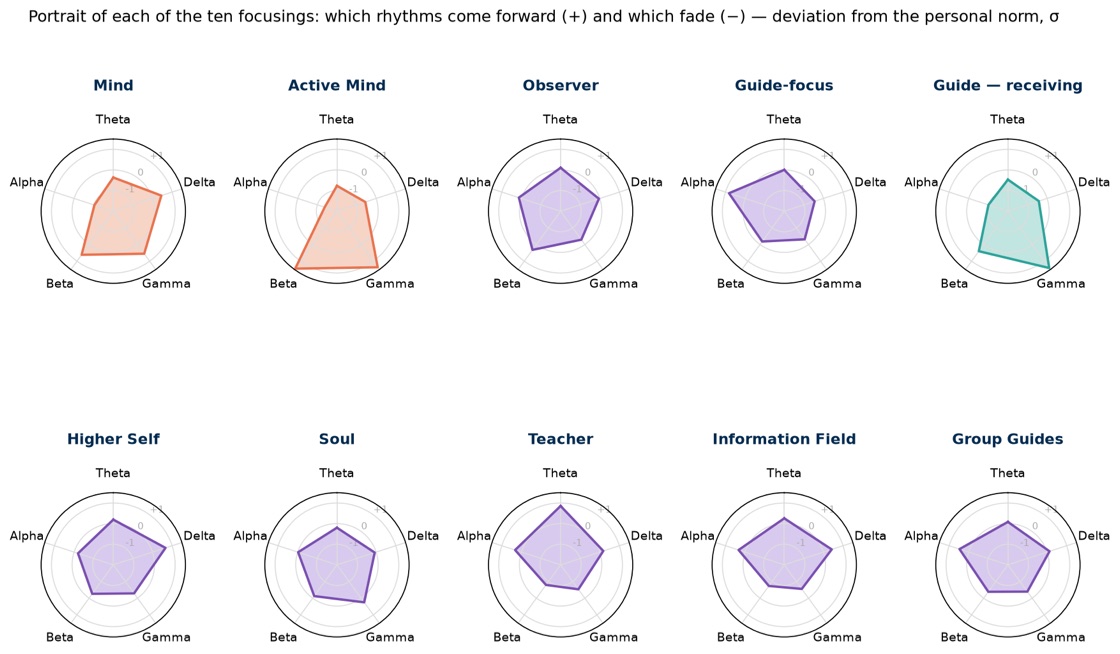
If you look at each type of attention focusing separately, its own recognisable electrical “character” emerges — which rhythm comes forward, which fades, and how the heart behaves. Below is a portrait of each of the 10 attention states in the experiment. The radar charts show which rhythms rise above the personal norm (the petal stretches outward) and which fall below it.
Mind — everyday information processing
This is the electrical portrait of a wholly unorganised mind busy with current affairs — the state in which a person spends most of the day. Fast rhythms prevail, relaxed alpha is suppressed, activity is smeared across the whole spectrum. In essence this is the “background noise” of waking consciousness: thoughts are there, but they are scattered and pull attention in different directions.
⭐ “The brain started proposing — I need to do this, I need to choose people… it started thinking up a plan and sorting through it”.
What it is like. For the brain it is a radio stuck between stations, or a browser with three dozen open tabs: everything hums at once, nothing sounds clear. For the practitioner it is the “default driver”, at the wheel almost all day, turning now onto one “road”, now onto another — hopping from thought to thought.
When to use it. Deliberately — almost never; it is the point of departure. It is useful to learn to recognise it, so as to notice the moment you have left it — or, conversely, quietly returned to it.
Active Mind is ordinary productive mental work, but in a version of calm collectedness, without the thrill and the race.
Observer — calm observation of the breath
This state looks like an even, neutral background: no rhythm leaps sharply forward, activity holds near a person's own average. Yet it is here that attention flows in the longest and smoothest waves, and the pulse drops. A good image of a “reset” and a return to a calm baseline — no wonder this state served as one of the control points in our study.
⭐ “I am all calm, but the mind is very fussy, standing guard… it is very hard for it to settle, though I am absolutely calm” (it becomes possible to see introspectively that there are two layers — Mind and Observer).
What it is like. For the brain — the surface of a lake at dawn: the surface is calm, rare slow rings move across it. For the practitioner — a camera on a tripod, filming neutrally; the operator neither snatches at anything nor comments.
When to use it. To reset the “background noise” accumulated over the day and return to neutrality. It is a basic step and a good “zeroing point” before entering any other focusing.
Higher Self — the structural architect
The most unusual feature of this state is a rise in delta-wave activity, the slowest rhythm, which in a waking person is usually almost absent and appears only in deep sleep. Here it strengthens while the person is fully awake, and the fast “analytical” rhythms retreat. It seems that in “Higher Self” some deep, usually hidden layer of activity switches on — and this fits well with how the practice describes the state: access to a view of the situation that goes beyond the person's ordinary mental analysis. Yet the body is by no means “asleep”: the pulse rises towards the end of the session.
⭐ “There is such calm and confidence, wonderful, on this second level”.
⭐ “When I felt myself in contact… I see how this is being solved right from my point”.
⭐ “The name of a specialist came up who would help develop a strategy for entering a new market”.
⭐ “It is a more neutral, objective view” — “more reasonable, wise, calm”.
⭐ “As if a self-sense of a different class… more self-worth”; and at the same time — “I fought off sleep the whole way… drifting into sleep and coming back, not working with the mind”. The rise of delta is audible in that “fight with sleep”.
What it is like. For the brain — an architect's drafting table: a quiet deep “hum of the foundation” (delta) switches on while the chatty analyst is damped. For the practitioner — a rise to satellite altitude, from which the whole “city” of the situation is seen at once, with all its streets and connections.
When to use it. To structure thoughts, write texts, build a plan and find the optimal way to solve a task. To write a letter, a post or a report when “it will not come” — to catch the flow and put it into words. This state turns the vague into concrete steps: rely on it when you need to break a tangled project, strategy or business plan into stages, gather a pile of tasks into a system and set priorities, plan a budget, a move or a renovation, understand what you want from a relationship and where it is going, build a clear routine with children. Important: the body engages here — this is a working state, not rest.
Soul — life meaning
By the pattern of brain rhythms, “Soul” is restrained — no rhythm dominates sharply. But by the relaxation of the body it is the calmest state in the experiment: the pulse is not only low, it goes on falling over the session. If “Teacher” and “Higher Self” switch the body on, “Soul” genuinely calms it. This fits its purpose — a state of inner connectedness and calm, not of active work.
⭐ “It showed me that I am in an enclosed space, in the dark, and there is no light… and when the light appears — the ships will float up towards it”.
⭐ “At first I sank into another state — like a swan that had been an ugly duckling, and then found out it was really a swan”, “nobility, breadth, calm”.
⭐ “It became clear that I have my own kindred soul, and the other person has theirs”.
⭐ “Soul is not interested in finances at all, it kept flying off somewhere”.
What it is like. For the brain — not separate instruments but an even warm glow, like the flame in a fireplace you gaze at without breaking into details. For the practitioner — a deep slow exhale and a sinking below the level of logic, to a sense of “what is truly important to me”.
When to use it. For real recovery — this is the only focusing in the experiment that genuinely slows the heartbeat. To bring taste and meaning back to life, to calm down, to come to yourself; it also serves as a gentle close to the day. “Soul” returns connectedness with oneself: it is real rest for the nervous system after overload and help when everything has lost value and it is unclear what it is all for — it returns meaning and richness. Rely on it in big choices — work, city, partner — that are decided by the heart and not by logic alone; through it, warmth and genuine interest in a loved one return, and you learn to feel a child with the heart rather than through anxiety and control.
Guide — the view from the side
“Guide-focus” produced the highest level of relaxed alpha activity in the whole study. This is a picture of calm, clear, open attention — the mind is neither strained nor drowsy; it holds a soft, steady clarity. It is precisely this “view from the side”, which lowers the pressure of emotions, that this focusing aims at. Separately stands its “active” version — “Guide — receiving text” — which looks completely different: there the gamma rhythm of “meaning-binding” comes forward, because the inner flow of the work of consciousness is at that moment being actively translated into words.
⭐ Of “Guide-focus”: “As if a suitcase was opened — and the brain began sorting through the details, tuning”.
⭐ “For most of the time — silence, silence, silence”.
⭐ “You sort of step in there — and the space becomes wide, and everything is subject to me there, a completely different state”.
⭐ “It showed me about a different rhythm, a different breathing… ‘sit firmly inside yourself’”…. “we take a fishing rod, sit down on the bank and look at the horizon”.
⭐ Of “Guide — receiving text”: “It was as if on a physical level the brain was stirring… I wrote down a text — about the laws of physics, fields, charge”.
What it is like. For the brain — a receiver finally caught on one clean station (an even alpha hum). For the practitioner — a calm companion beside you, who gently turns down the volume of the emotions and shows the situation from the bank while you flounder in the water.
When to use it. When you need to think clearly and calmly, hold your direction and not let emotions grab the wheel; it helps you collect yourself under overload and make a hard decision “with a cool head”. This focusing lowers the power of emotions and returns steadiness: mid-quarrel — to step out of the emotion and look at the conversation “from the balcony”, without saying too much; when a child has pushed you to the edge — to keep a calm tone and see the whole situation; in a difficult talk with a boss or client — to keep a cool head; with anxiety, panic and the “mental carousel” before sleep — to place yourself beyond the anxiety; and when it is “storming” — to stabilise and not decide in haste.
Guide — receiving text
This is the active, working version of the “Guide” focusing, and by brain waves it is the complete opposite of the quiet “Guide-focus”. Here the gamma rhythm of “meaning-binding” comes forward while relaxed alpha retreats: the inner flow of attention is in these minutes being actively translated into words and written down, so the eyes keep opening, and the blink rate becomes the highest of all the states. In essence this is a mode of active mental work directed not outward, as in the Scrabble game, but at putting into words the ideas and meanings that are becoming available.
⭐ “As if on a physical level the brain is stirring… I need to re-tune the brain's work, re-tune the waves”.
What it is like. For the brain — a telephone switchboard feverishly connecting lines (gamma “stitches” meaning together). For the practitioner — a simultaneous interpreter typing live subtitles to an incoming stream.
When to use it. When you need to catch a flow of ideas and shape them into words: to write “from the state”, to record thoughts as they appear stage by stage.
Teacher — the strategic catalyst
“Teacher” produced the sharpest contrast between the measures of brain and body. By EEG this is the quietest of the “working” brain states: beta (the rhythm of active analysis) is suppressed more than anywhere, and theta comes forward — the rhythm of imagery and creative “flow”. The cortex seems to clear a lane, stops “producing” and switches to a receiving mode. But it is in this quiet brain state that the heart revs up more than anywhere in the experiment. A quiet head, rich in imagery and insight, with a mobilised body — this is the portrait of the “catalyst”: not excited thinking but calm, deep engagement.
⭐ “With the Teacher there were more ideas”.
⭐ “Right in that moment you understand that the Teacher is touching something in your consciousness, guiding it”.
⭐ “Now the Teacher was teaching me… any model can turn out well — the main thing is to pick the right ‘puzzle pieces’”.
⭐ “Something very serious, tears welling up… it showed me a little bird, led me underground, taught me to connect consciousness with the body, to mould legs and arms from clay”.
⭐ “So much energy came… I have not felt such an energising in a long time, literally like currents”.
What it is like. For the brain — a darkened recording studio: the light dimmed, the cortex hushed — while behind the scenes the heart pounds. For the practitioner — a furnace in which frozen forms are melted down under heat: you are beside one who has gone far ahead in mastery, and you allow your habitual patterns to be re-moulded.
When to use it. For breakthrough, “re-assembling” work, leaps in learning, strategic vision and insight. It is the hardest focusing to enter and a state of high engagement — not for rest. “Teacher” re-assembles thinking and gives non-standard moves: it pulls a stuck project out of a dead end and helps you see it “for growth”, lets you master a skill faster and go beyond habitual solutions, re-assembles a stuck scenario (“always the same quarrel”), finds a new approach in parenting when the old one does not work, shifts a behaviour or a habit that “will not move”. Important: high concentration and a quickened pulse are also real work, not relaxation.
Earth's Information Field
This is a tuning of focus onto the shared information space, and by its electrical picture it turned out to be the most “ordered” state of all: power is gathered most tightly around the leading rhythms, and the fast “analytical” waves are damped. But its most expressive marker is the eyes. The blink rate here drops to the minimum in the whole study: the gaze literally freezes, which usually accompanies a deep turn inward, when the outer world stops demanding attention. This is a portrait of maximally inward concentration, detached from the external.
⭐ “As if it is not an escalator but the take-off of an aeroplane”.
⭐ “In some other space, as if in another dimension — I walked there, and the parameters there are different”.
⭐ “I need to pass this charge to the Soul energetically”.
⭐ “It was as if I was plugged into a socket — a current ran through me… a re-flashing at the cellular level”.
⭐ “In the information field a whole system built itself for me — a model of puzzle pieces: any idea can be realised, the main thing is to follow the algorithm from the end goal back to the steps”.
What it is like. For the brain — the most precise “tuning” of all, with the eyes frozen: as if you dive to the bottom of a still pond, and the surface closes over you. For the practitioner — a “download” mode for a whole system or model, when the outer world with its habitual connections seems no longer to exist.
When to use it. When you need to detach from the external and gather an idea into a system, to see how its parts fit together; for deep work that requires full inner immersion.
Group Guides
Tuning onto the shared group by brain rhythms looks peaceful — calm alpha and a low pulse, like the other “collected” states. And it is precisely here that the most striking discrepancy of the whole study arises, discussed in detail in the next section: with an outwardly calm cortex, this state was experienced as a peak of emotion, and the only objective trace of arousal was a record level of jaw-muscle tension. The body was keyed up muscularly, yet in the brain rhythms this was almost not reflected.
⭐ “Very, very strong feelings, goosebumps — is putting it mildly. Fifteen endless minutes — how can one feel pleasure and engagement for so long!”.
What it is like. For the brain — a calm cortex with a humming body (goosebumps, sweat): this is the device's “blind spot”. For the practitioner — a concert where the hall weeps with delight while the seismograph barely twitches.
When to use it. For deep emotional and “energetic” experiences, group tuning and resonance — but a consumer device (like the Muse 2) will barely “see” their strength, and that is fine.
Body and eyes: two honest channels besides the brain's EEG
Besides the rhythms, the device notices two simple, almost everyday things — how often a person clenches the jaw and how often they blink. Both signals turned out to be telling in their own way.
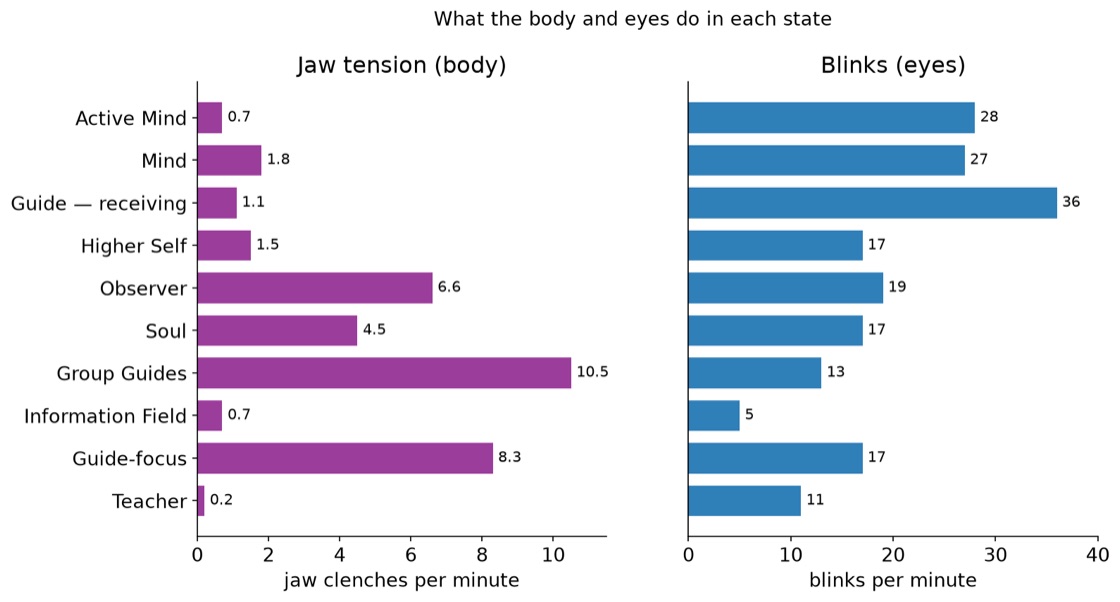
Jaw clenching is also important as an honesty check. The gamma rhythm has long been “under suspicion”: it is easily faked by tension in the facial and jaw muscles, so high gamma is always suspected of being mere muscle noise. But the data remove that suspicion: in the states with the highest gamma activity — “Guide — receiving text”, “Active Mind”, “Teacher” — the jaw is, on the contrary, calmest of all (fewer than two clenches per minute). So the measured share of gamma waves there is real, cortical, and not a consequence of facial tension. Curiously, jaw clenching in itself is not an “emotion detector”: it is noticeable in several calm states with the eyes closed too (“Guide-focus”, “Observer”, Group Guides, Soul).
Most likely this is a sign of a relaxed, motionless seated body: a slack, slightly open jaw that periodically closes, swallowing saliva and small posture adjustments, plus a light slide into drowsiness (confirmed by head tilt on the accelerometer and by a check against the video recording, where the face is relaxed and the jaw not clenched). The one exception is “Group Guides”, where a high “jaw” may already reflect a real bodily response to an emotional surge (goosebumps, tears, holding back feeling). In other words, in most cases this is the calm expression of a body gone inward, not a marker of effort or stress.
Blinks, meanwhile, give us a separate axis — “gaze outward or inward”. “Guide — receiving text” sets the record (about 36 blinks per minute): the eyes keep opening (part of the group wrote down the incoming text, part actively reflected). And “Information Field” gives the anti-record (about 5): the gaze literally freezes — by this measure it is the most detached-from-the-external, the most introspective state of all.
Until now the participants' words had confirmed the sensors' readings. But one case broke from this agreement so strongly that it became a finding in its own right. This is the “Group Guides” state — a tuning onto the shared group (the image of the “Guides” of all the participants). By experience it was the peak of the whole study: participants described it as an explosion of feeling. “Very, very strong feelings, goosebumps is putting it mildly. Fifteen endless minutes — how can one feel pleasure for so long”. “Apparently the hormones kicked in — I broke into a sweat”. One would think the electroencephalogram should be raging with a storm.
But the instruments showed almost the opposite: a calm cortical alpha profile and one of the lowest pulses. The only objective trace of this emotional storm was jaw-muscle tension — in “Group Guides” the jaw clenched more often than in any other state. That is, the body was muscularly tense, but in the brain rhythms themselves the storm was almost not imprinted. The richest experience passed by the four electrodes.
Something similar happened with the half-hour version of “Guide-focusing” (without writing text down). Subjectively it was the deepest and most intimate contact of the whole experiment: “My whole life flashed before my eyes in half an hour — a reformatting… the body seemed to be healing”. Yet by the instruments the “calm collectedness” did not rise at this time but fell, and the pulse went up — that is, the depth of the experience ran not along the line of serene alpha but along the line of strong emotional involvement.
It seems that consumer EEG catches the “mechanics” of a state well — load, relaxation, the work of the eyes and muscles — but poorly conveys the richness of subtle inner contact.
The conclusion matters both for the practitioner and for a sober view of “neuro-gadgets” in general. The device is not a judge of the depth of experience: the absence of a pretty chart does not mean “nothing happened”, and the strongest inner experience may leave almost no trace in the brain rhythms. Objective measures are good as a guide to the mechanics of attention (am I collected or scattered, relaxed or tense), but to measure the value or authenticity of inner contact directly with them would be a mistake.
Where honesty matters more than a neat conclusion
What the device could not make out
We repeated the same strict “guess the state” test on four subtle, deeply inner focusings — “Higher Self”, the two versions of “Guide”, and “Group Guides”. This time the algorithm dropped to the level of random guessing. This means that although Muse confidently tells “active” states from “resting” ones, it does not distinguish the most subtle contemplative states from one another. It is important to understand that this does not prove that nothing happens inside them — it only says that a coarse device with four electrodes is not enough to catch the difference, if there is one. So the bold claim “every state is unique and unrepeatable” we can confirm only partly (for 7 of 10 — yes), and we say so honestly.
The ladder of difficulty — and why the instruments see it differently
Let us return to the ladder of focusing difficulty from the start of the article — Mind, Observer, Higher Self, Soul, Guide, Teacher. A natural question arises: is this ladder visible in the data — do the “higher” steps somehow become “stronger” or “more extreme” by the instruments? The answer is no, and this in itself is important. If you arrange the states by the similarity of their brain rhythms, the picture is built not by difficulty but by type of activity.
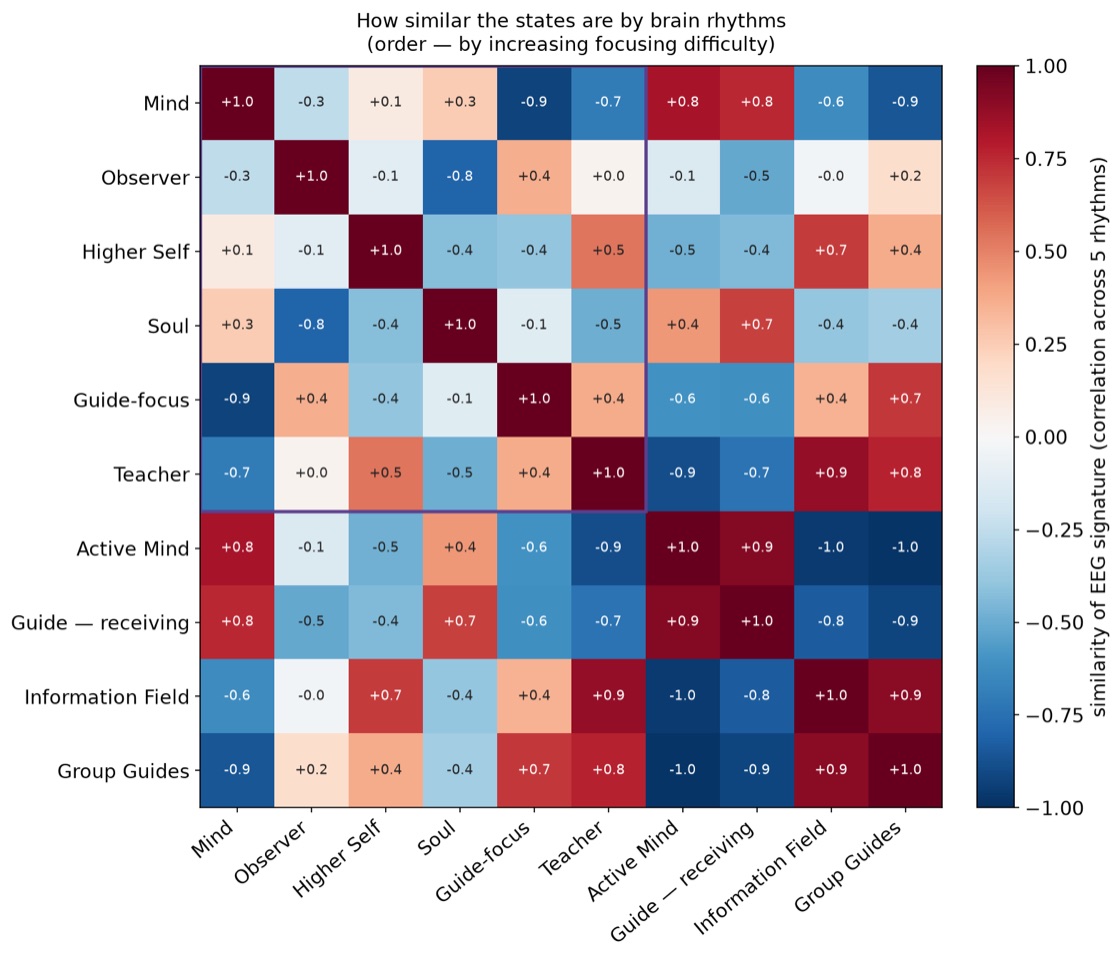
The most telling example is precisely “Higher Self” and “Teacher”. On the ladder of difficulty they stand far apart: “Higher Self” is one of the more accessible steps, “Teacher” the hardest. Yet by the brain measures they turn out to be close neighbours (their signatures are markedly positively linked) and fall into one “family” together with “Information Field”: a quiet cortex, damped in fast rhythms, with an active heartbeat — that same pattern of “high” states from the second finding. And conversely: “Higher Self” and “Soul” stand next to each other on the ladder but are almost opposite by rhythm. Meanwhile “Mind”, “Active Mind” and “Guide — receiving text” cluster into a separate “working” family, where the brain is busy with active processing.
The device shows the destination — what type of state a focusing turns out to be — but not the effort and skill needed to get there. The difficulty of a focusing is a property of the path, not of the electrical “snapshot” at a given minute. So, hypothetically, two states may look like neurophysiological relatives and yet be at opposite ends of the ladder of mastery. For the practitioner this is both reassuring and cautionary: even a beginner can, for a minute, land in a state whose “handwriting” resembles a far more advanced one — but the real difference (stability, ease of entry, depth of contact) lies in what the consumer device may not be catching.
A map of the states: only two “tuning knobs”
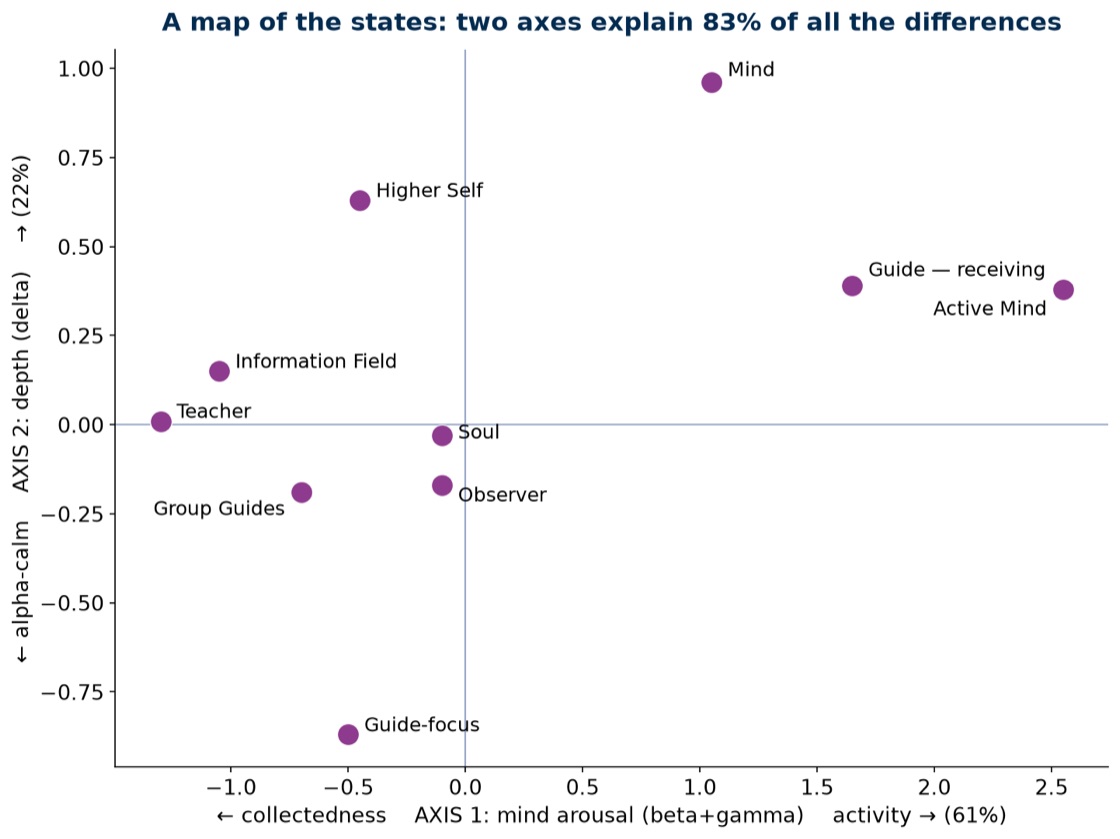
We measured five different brain rhythms, and one might have expected the states to differ from one another in five independent ways. But that was not so. When we analysed the data deeply, trying to find out how many independent “directions of difference” between the states actually exist, it turned out that 83% of the differences fit into just two axes.
The first axis — the most important, accounting for 61% of the differences — is the degree of arousal of the mind. On its right are the states where fast rhythms of strained work prevail (beta and gamma), and on the left where calm alpha takes over. In plain terms this is a scale of “active mind ↔ collected mind”. The second axis, another 22%, is depth: does the quietened mind go into light alpha-relaxation or plunge into delta waves, the slowest rhythm, which usually appears only in deep dreamless sleep, and here arises in a fully awake person.
The easiest way to picture this is as a map. Any city on Earth has thousands of features, but to find it on a globe two numbers are enough — latitude and longitude. Our ten states are just such “cities” on a map of consciousness, and each has only two coordinates: one shows how active the mind is, the second how deeply it sinks. With two “tuning knobs” — “how switched-on is the mind” and “where does it go, into calm or into depth” — almost any of these states can be described.
This, incidentally, explains why the subtle inner states are so hard to tell apart with instruments: on this map they crowd into one corner — all “collected”, all with high alpha activity, and the distances between them are quite small. And “Higher Self” pulls away from its neighbours upward, along the second axis: it too is calm, but it deepens not into alpha but into delta rhythm.
Four steps of one ladder: Mind, Higher Self, Soul and Guide
When the Scrabble game and the text-writing during the “Guide” focusing are present in the analysis, these “loud” states pull all the instruments' attention onto themselves and drown out the subtle differences between the rest. So we looked separately at 4 focusings — the ordinary Mind as a reference point, Higher Self, Soul and Guide-focus — and asked: how do they differ from one another?
It turned out that these are not four different “islands” but four steps of one ladder — a ladder of deepening relaxation. As you climb from Mind (the most active) through Higher Self and Soul to Guide-focus (the most relaxed), several things change together: the share of calm alpha waves grows (from 29 to 43 percent), “collectedness” — the alpha-to-beta ratio — grows, the brain signal becomes ever more “tuned” and less noisy, and — most vividly — the head physically drops lower and lower: from about four degrees of tilt in Mind to sixteen in Guide-focus, as if the body lets itself go a little more with each step.
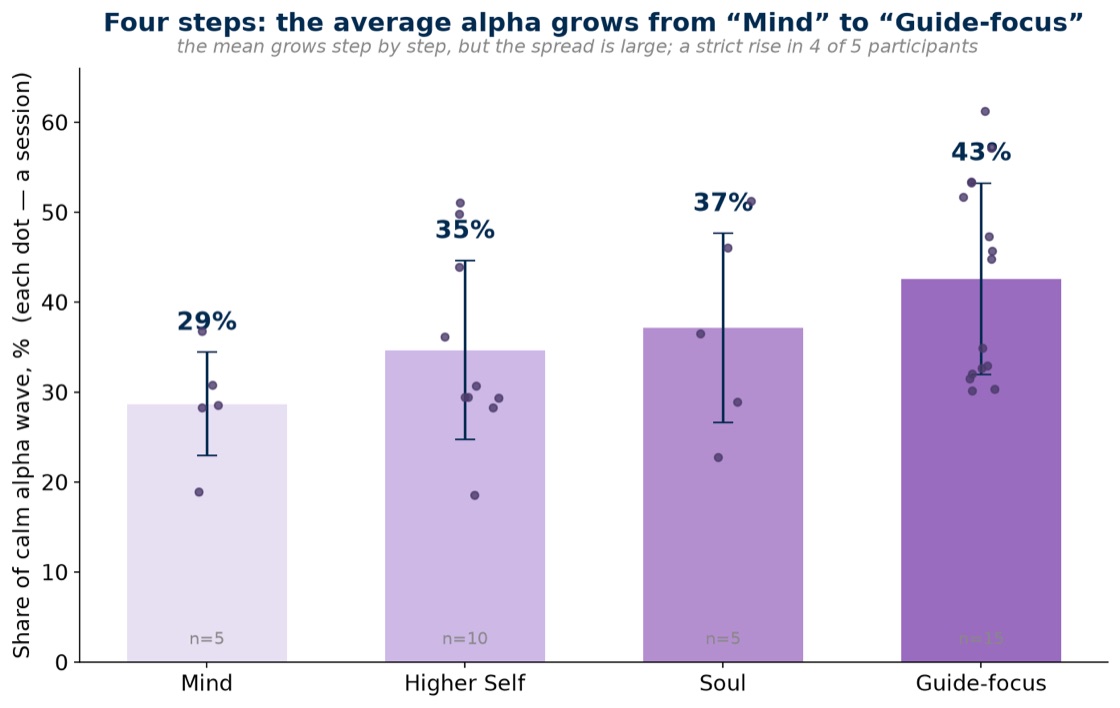
Since these are steps of one ladder, not separate locked rooms, the device sees the general movement “deeper and calmer”, but cannot reliably tell one state from its neighbour on a single recording — they flow smoothly into one another. Imagine a dimmer switch on a lamp: the difference between “bright” and “dim” is easy to feel, but two neighbouring positions are almost indistinguishable. These four states are positions on one such dimmer, not four different lamps.
But once again “Higher Self” stands out from the general row. On the ladder of relaxation it sits between Mind and Soul, but it deepens in its own way — not through alpha but through the delta rhythm, those very slow waves of deep sleep that arise here in a fully awake person. To continue the lamp analogy: the other states simply grow dimmer, while “Higher Self” seems to switch to a special deep warm light — where it is not “less light” but a different quality of it.
Summary: what the instruments showed and what the participants said
If you gather all the states into one table, the main thing is visible: in most cases the instruments and the experience agree, and only in one do they sharply diverge.
| Focusing | EEG handwriting | Experience (essence) | Link |
|---|---|---|---|
| Observer | even background, low pulse | “just presence”, but the mind is fussy | agrees, with a nuance |
| Active Mind | beta/gamma up, alpha down, pulse minimum | calm game “without speed” | agrees |
| Mind | alpha down, beta/gamma up, pulse up | “jumps”, nervous, tension | agrees |
| Guide-focus | maximum alpha | drifting into sleep, “sitting on the bank” | strongly agrees |
| Guide — receiving text | maximum gamma, maximum blinks | “the brain stirs”, writing text | strongly agrees |
| Higher Self | maximum delta, pulse rises | fighting sleep; “courage, flight” | agrees, but pulse diverges |
| Soul | cortex neutral, body quietest | indifferent to the theme, pulls into sleep, contact | strongly agrees |
| Teacher | maximum theta, beta minimum, pulse maximum | imagery, “energising by currents”, tears | agrees (cortex ↔ heart contrast) |
| Information Field | blinks minimum, beta down | “a current through me”, “a system of puzzle pieces” | agrees |
| Group Guides | alpha up, pulse down, jaw maximum | peak of feeling, goosebumps, sweat, pleasure | diverges |
| Guide-focus, 30 min | α/β fell, pulse rose | intimate contact, tears, “life before the eyes” | longer ≠ deeper |
What to do with all this — and why it is useful
If you put the three findings together, you get a conclusion far more precise and interesting than the familiar “meditation relaxes”. Conscious focusing is not a switching-off or a going-limp, but a fine tuning that has at least three distinguishable levers.
- It brings order to the brain's electrical activity, gathering it around a single leading rhythm.
- It changes the tempo of attention, slowing it into long smooth waves.
- And it is able to move mind and body to different sides — to calm the head while mobilising the body, or, conversely, to calm both.
And where the experience diverges from the instruments, we get an important lesson in humility: the strongest inner contact may leave almost no trace in the brain rhythms, and one cannot judge the value of a state by the “beauty of its chart”.
For a person learning the practice, this translates vague inner sensations into concrete, distinguishable states with a clear purpose — and suggests which of them to choose for which life task.
The practical sense is simple. If you need to truly recover and calm the nervous system, “Soul” works — the only state that significantly calms the heart rhythm. If you need to think clearly and collectedly, without fuss, the “Guide” focusing helps, with its peak of relaxed alpha. If complex, generative, “re-assembling” work lies ahead, “Teacher” and “Higher Self” suit it — but remember that these are states of activation, not rest, and the body in them works actively. And measures like the “tunedness” of the spectrum and the tempo of attention may in time become objective guides in learning: by them you can see whether a person has really gathered attention to a point or only thinks they have.
If you boil this down to a simple map you can hold in your head during practice, it comes out like this:
| If you need to… | State | Why — by the data |
|---|---|---|
| recover, calm the nervous system, come back to yourself | Soul | the only state that really slows the heart; the body is quietest |
| shed the accumulated background, return to neutral | Observer | even rhythm background, the longest calm attention waves, low pulse |
| think clearly and calmly, hold focus without fuss | Guide-focus | peak of relaxed alpha, maximum “calm collectedness” |
| structure, plan, see the situation whole | Higher Self | damped fast rhythms — but the body activates, this is not rest |
| detach from the external and build a system, a model | Information Field | the most “tuned” spectrum, gaze freezes inward (minimum blinks) |
| catch a flow and shape it into words, into text | Guide — receiving | peak gamma — active “meaning-binding”, the eyes engage in the work |
| breakthrough, “re-assembling” work, learning, insight | Teacher | quietest cortex and an imagistic theta flow — but the heart revs up, this is activation |
The data show: the “higher” states are not for rest. Teacher and Higher Self calm the head but mobilise the body, so using them as a way to relax before sleep is not advisable — for that there are Soul and Observer.
And the next step from here is obvious: to repeat the same states on a larger group, recording the brain together with detailed heart and breathing work, and at several points in time. If the three effects hold up, our study will cease to be a pilot and become a full one.
Six months later, for all the participants (living in different countries), what shifted was not so much the objective financial picture as the very type of relationship with money. The objective indicators, meanwhile, went in different directions — from the highest revenue in the whole history of their work to a cash-flow gap, partly linked to global changes in the economy — but the subjective transformations proved to be in one direction across the whole group.
The common shift — from avoidance and fear to acceptance and steadiness:
Money stopped being something the psyche defends itself against. One participant saw that she used to unconsciously “skirt money” and hurry to free herself of it, unable to hold it; now — a clear “I need this, I am ready to receive” and an intention to build a mature, responsible system.
Attention turned towards materiality and the present moment. An inner freedom appears: permission to experiment with formats of activity instead of searching for one “right” option.
The psyche's capacity widened. In the most acute case — objectively a “nightmare” (debts, a high-interest loan, illiquid assets), but the participant for the first time calmly lives through what had been her main, root fear (“there is nothing scarier than poverty”). The psyche “became much wider” — able to let through events and take actions on which, two years earlier, it would have placed an absolute ban (“I will not survive this”).
The growth of confidence showed in concrete actions — raising the price for her work (in one case doubling it), a readiness to close what does not work and not cling to it, giving up the former strategy of freezing (“collapsing into an egg”).
Objective positive dynamics were achieved — a revenue record broken twice, and the goal set at the strategic planning session reached.
The focusings worked not for everyone at the level of income figures, but at the level of the psychic structure of the relationship with money — removing avoidance, fear and contraction and forming a more mature, calm and active stance. Tellingly, steadiness and inner freedom grew even in those whose financial position objectively worsened: the inner state stopped being an absolute hostage of external indicators.
How this was computed — for those who care about the details
The basis is Muse 2 recordings over 4 days in October 2025: 70 sessions of 15–30 minutes, about 66,000 data points after discarding fragments with poor sensor contact. Each state was compared with the others within the same person (normalised to a personal mean) — so that differences in the baseline rhythm levels between people would not distort the picture. Instead of absolute rhythm power, their relative share was taken, robust to the quality of the device's fit. “Order versus chaos” is the spectral entropy of the distribution of power across the five rhythms (0 — all power in one rhythm, 1 — evenly across all); “tempo of attention” is the autocorrelation time of the alpha envelope; the link between mind and body is the correlation between overall brain arousal and pulse. Friedman and Wilcoxon tests, a permutation classifier with a “new person” check, and effect-size estimation were used; high gamma was separately checked for muscle artefacts against jaw-clench markers and head movement.
Limitations. This is a pilot study on a small group, so everything described is a well-founded hypothesis rather than a definitively proven fact; at this sample size, even a perfect agreement of direction across all participants corresponds to a significance level of about 0.06. Spectral entropy is closely linked to the α/β ratio — a different view of the same reorganisation, not an independent measurement. A device with four electrodes does not localise activity by brain region; the frontal sensors often lost contact, so the frontal alpha asymmetry (a popular emotion measure in Muse studies) could not be computed reliably.3
The device has been used in more than 200 peer-reviewed studies (NASA, Harvard, MIT, the Mayo Clinic, the universities of Toronto, Victoria, London, San Diego and others). All interpretations are pilot-level hypotheses.
Processing and analysis. Preprocessing: filtering by the contact-quality indicator (HSI) and HeadBandOn; conversion of logarithmic band powers to linear with averaging over the working electrodes; computation of relative band power; centred log-ratio (CLR); within-subject z-normalisation; stitching of segments and linear interpolation for time alignment.
Statistics: the Friedman test, Kendall's coefficient of concordance (W), the Wilcoxon signed-rank test, the Mann–Whitney test, Pearson and Spearman correlations, permutation tests. Classification: leave-one-person-out cross-validation, a nearest-centroid classifier in the space of z-features, a permutation null for estimating the chance level — applied to recognising both state and identity (a “neuro-fingerprint”).
Structure and signals. Principal component analysis (PCA via singular value decomposition, SVD) — the “two-axis map”; hierarchical clustering by Ward's method on the correlation matrix of state similarity. Time-series measures: Shannon spectral entropy (spectral orderliness), the autocorrelation time of the alpha-rhythm envelope (the tempo of its modulations), the coefficient of variation (variability of composition), ordinary least-squares linear regression (trends), detrending, Welch's method for spectral density, a Butterworth filter, magnitude-squared coherence and circular-shift surrogates (a check of inter-brain synchronisation), cross-correlation of rhythm envelopes.
Physiology and behaviour: pulse statistics, frontal alpha asymmetry, from the accelerometer — the RMS of the magnitude (mobility) and head tilt via arctan, counts of blink and jaw-clench markers.
- Krigolson O.E., Williams C.C., Norton A., Hassall C.D., Colino F.L. (2017). Choosing MUSE: Validation of a Low-Cost, Portable EEG System for ERP Research. Frontiers in Neuroscience, 11:109. doi:10.3389/fnins.2017.00109.
- Krigolson O.E. et al. (2021). Using Muse: Rapid Mobile Assessment of Brain Performance. Frontiers in Neuroscience, 15:634147. doi:10.3389/fnins.2021.634147. → assessment of brain performance / cognitive fatigue (large-scale data collection, University of Victoria).
- Cannard C., Wahbeh H., Delorme A. (2021). Validating the Wearable MUSE Headset for EEG Spectral Analysis and Frontal Alpha Asymmetry. IEEE Int. Conf. on Bioinformatics and Biomedicine (BIBM), p. 3603–3610. (bioRxiv preprint: doi:10.1101/2021.11.02.466989). → what Muse measures reliably (the spectrum) and what it does not (frontal asymmetry).
- Young J.H., Arterberry M.E., Martin J.P. (2021). Contrasting Electroencephalography-Derived Entropy and Neural Oscillations With Highly Skilled Meditators. Frontiers in Human Neuroscience, 15:628417. doi:10.3389/fnhum.2021.628417. → reduced EEG entropy in experienced meditators (≈22,000 h of practice: shamatha, vipassana, dzogchen and others).
- Bird J.J., Manso L.J., Ribeiro E.P., Ekárt A., Faria D.R. (2018). A Study on Mental State Classification using EEG-based Brain-Machine Interface. 9th IEEE Int. Conf. on Intelligent Systems (IS), p. 795–800. → distinguishing “relaxation / neutral / concentration” states by Muse with high accuracy.
- Balconi M., Crivelli D., Fronda G., Venturella I. (2019). Effects of technology-mediated mindfulness practice on stress: psychophysiological and self-report measures. Stress, 22(2):200–209. doi:10.1080/10253890.2018.1531845. → a month of practice with Muse lowers stress (Catholic University of Milan).
- InteraXon Inc. Muse Research. choosemuse.com/pages/muse-research (accessed: June 2026).
- Williams N. et al. (2024). Exploring the Utility of the Muse Headset for Capturing the N400. PMC11679084. → the aggregate claim “200+ peer-reviewed works; labs at NASA, Harvard, MIT, the Mayo Clinic and others”. The source is the device manufacturer, not an independent publication.